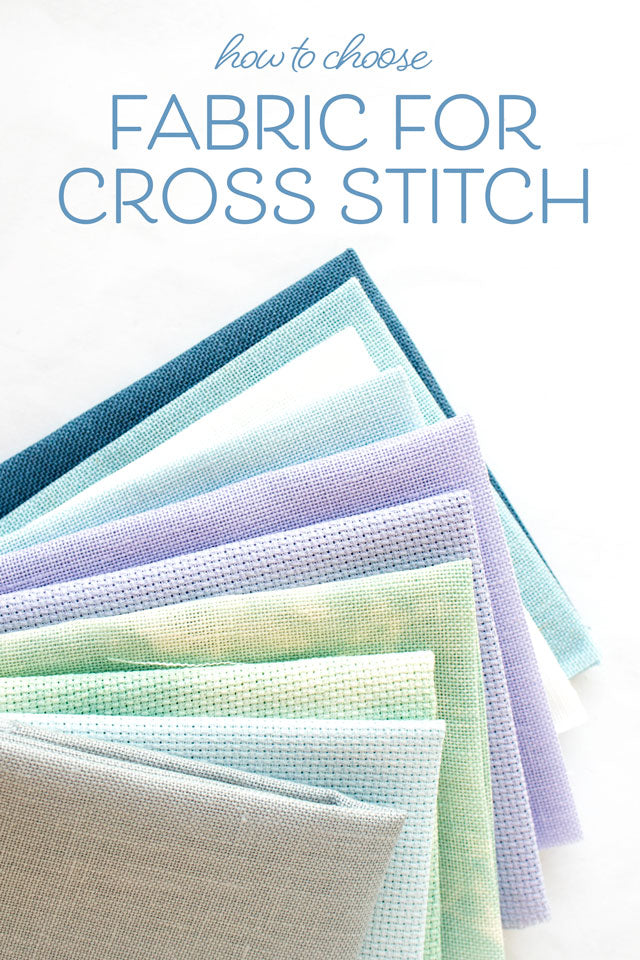


Choosing fabric for a cross stitch project can seem overwhelming. There are several different types of fabric suitable for cross stitch, and each has its own unique texture, feel, fiber content, and range of colors. In this post we will take a look at the pros and cons of main types of fabric - Aida, linen, and evenweave - so you can choose with confidence.
Aida cross stitch fabric
Aida fabric is one of the most widely used cross stitch fabrics. Made from 100% cotton, Aida is a particularly good choice for beginners because the wide, open weave makes the holes easy to see.
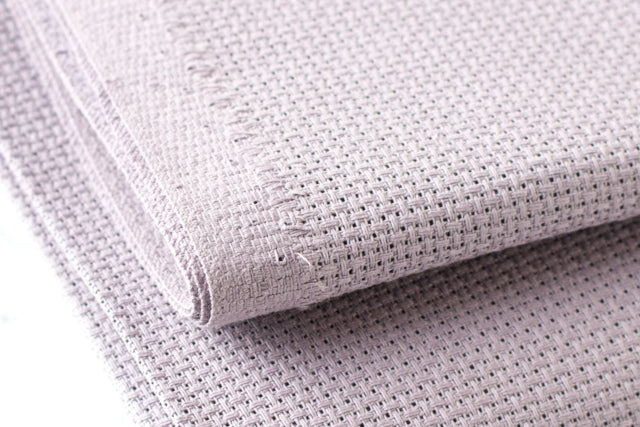
Aida was created specifically for cross stitch in the late 1800's or early 1900's by the Zweigart company in Germany. Zweigart remains one of the largest manufacturers of Aida today. Other makers include Wichelt (Permin) and Charles Craft. There are also a number of small indie makers who are hand dying Aida (as well as linen).
Aida comes in different fabric counts. A fabric's count is the number of holes per inch, which in turn determines the number of stitches per inch. (For more see What does fabric count mean in cross stitch?) Aida in 14 count is easy to find and is a good choice for stitchers who are just starting out. Other common counts are 11, 16, 18, and 20.
Aida also comes in a 6-count version called Herta that is perfect for teaching children to stitch or for chunky “big stitch” projects.
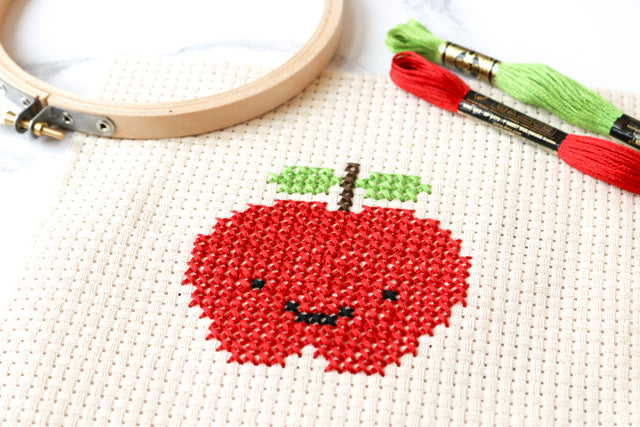
Fiddler's Cloth is similar to Aida in its weave, but is made of 50% cotton, 42% polyester, and 8% silk. It comes in 14, 16, and 18 counts and is popular for its rustic oatmeal coloring.
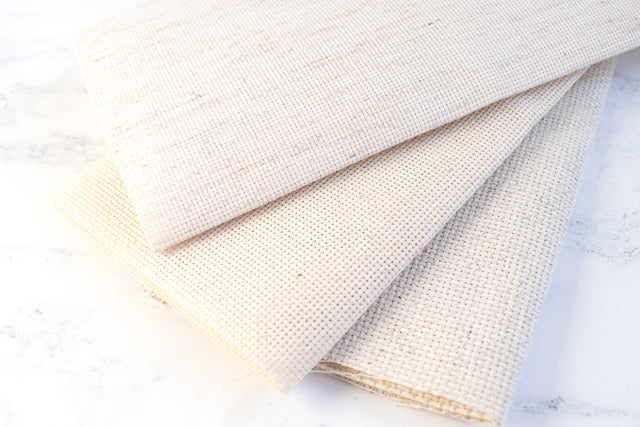
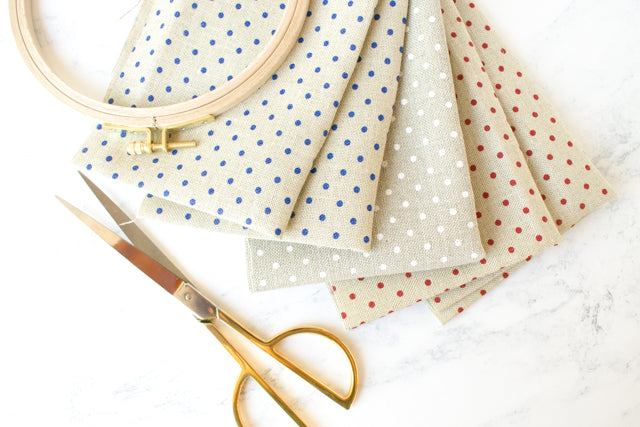
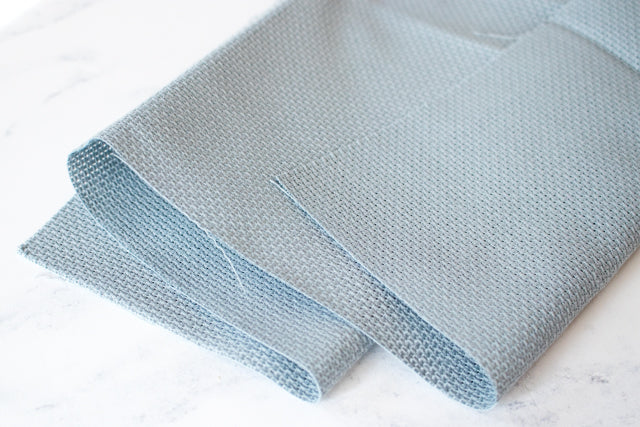
Aida is typically stitched over one and can be stitched with or without a hoop. It comes in a range of colors, including hand dyed and novelty printed styles. Aida is starched, so it is fairly stiff. Wichelt makes a version of 100% cotton Aida called Country French that has a softer feel. It's a good choice if you don't like the stiffness of regular Aida.
As for how to pronounce Aida, that's a long-running debate. Most pronounce it AY-da, but some say I-EE-da like the Verdi opera. Either works!
PROS: Readily available and comes in lots of colors and counts. Easy to stitch, so it's perfect for beginners and novice stitchers.
CONS: Because of its large, open weave, Aida has a coarser finish than linen or evenweave (but it's a look that lots of people love). It's not a great choice for more advanced patterns that use fractional stitches like 1/4 or 3/4 stitches.
(Shop our full selection of Aida here)
Evenweave cross stitch fabric
There was a time when evenweave referred to fabric that had the same number of warp and weft stitches per inch. This is desirable for cross stitch because an even weave means even (i.e., square) holes for stitching.
Today, almost all cross stitch fabric has an even weave, and the term evenweave has come to refer to the uniform, or even, fibers that make up the fabric. It means the fibers all have the same width so you don't have to deal with slubs or other inconsistencies.
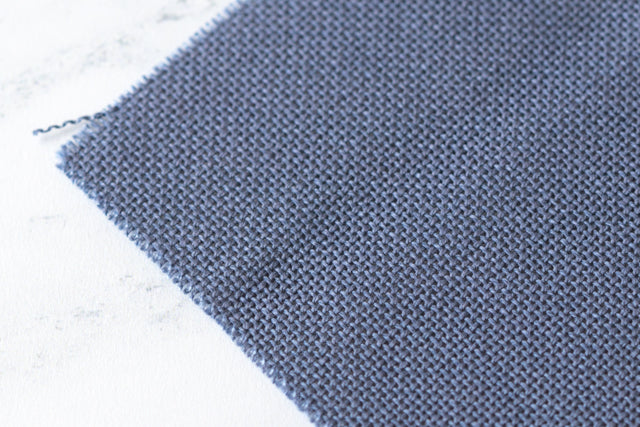
Evenweave has a higher thread count than Aida, and is commonly found in 25, 28, and 32 counts. Like linen, evenweave is generally stitched over two, although also like linen it can be stitched over one.
Evenweave fabrics are typically cotton/rayon blends. Zweigart produces a 52% cotton/48% rayon evenweave called Lugana, while Wichelt makes a 51% cotton/49% rayon version called Jobelan.
PROS: With its consistent texture, evenweave is a great fabric to use when learning to stitching over two. Good for advanced patterns with fractional stitches.
CONS: More refined in appearance than Aida, but still less so than linen. Some evenweave fabric can be stiff. Not quite as widely available as linen or Aida.
(Shop our full selection of evenweave here)
Linen cross stitch fabric
Linen is the choice of many experienced cross stitchers for its soft hand and higher thread count. Linen is a natural cloth woven from flax fibers. Typically it is more expensive than cotton fabric like Aida.
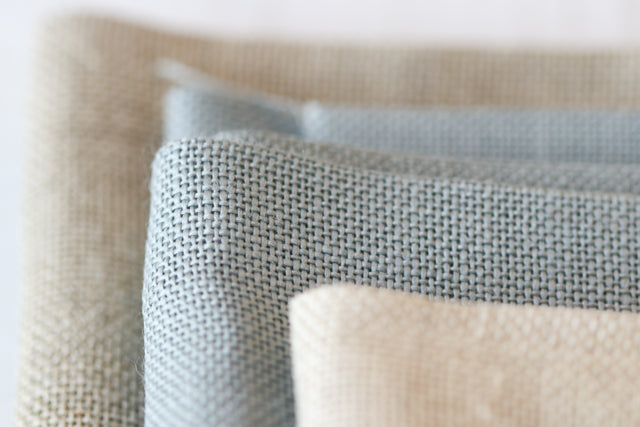
Linen can have natural irregularities like slubs and threads that vary in thickness throughout the weave of the fabric. Those irregularities can make linen more challenging to stitch on, but they also give the fabric character and offer a more traditional-looking finish.
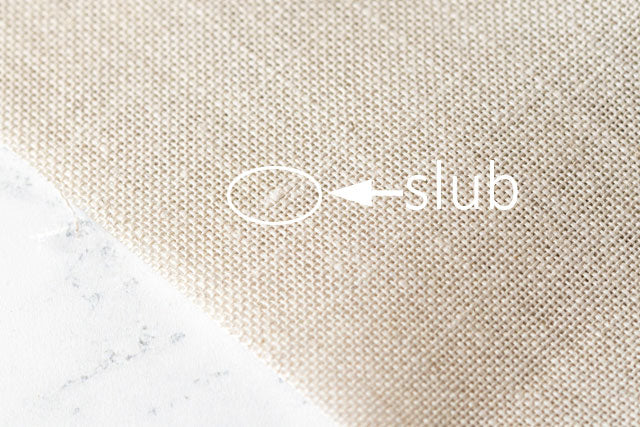
The weave of various types of linen also varies. Some is woven with thicker fibers so it feels more dense. Others are more loosely woven with larger gaps between the fibers.
Linen is typically stitched over two and is available in a wide range of thread counts, with the most common being 28 and 32 count. Thread counts can go as high as 40 and even 50! There is also a large color range to choose from, including hand dyed and novelty prints. Linen can be stitched with or without a hoop.
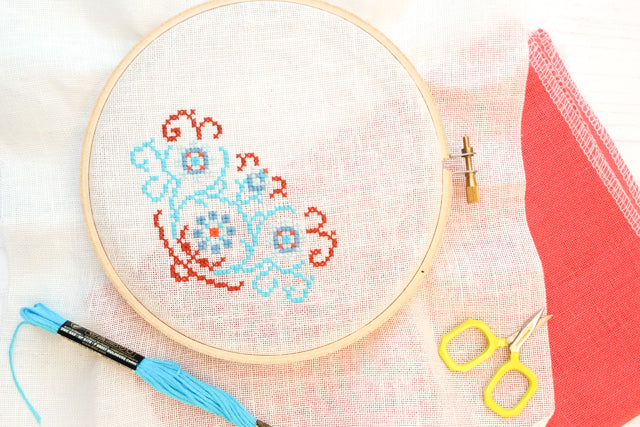
Zweigart and Wichelt are the two largest linen manufacturers. Cashel linen is Zweigart's name for its 28-count 100% linen fabric, while Belfast linen refers to its 32-count version. Zweigart's linen generally has a softer drape than the linen produced by Wichelt.
PROS: Widely available in a range of counts and colors. Feels good in the hand. Has a durable and elegant finish. Good for advanced patterns with fractional stitches.
CONS: Inconsistencies in the fabric can make linen harder to stitch on.
(Shop our full selection of evenweave here)
Yardage, banding, and prefinished options
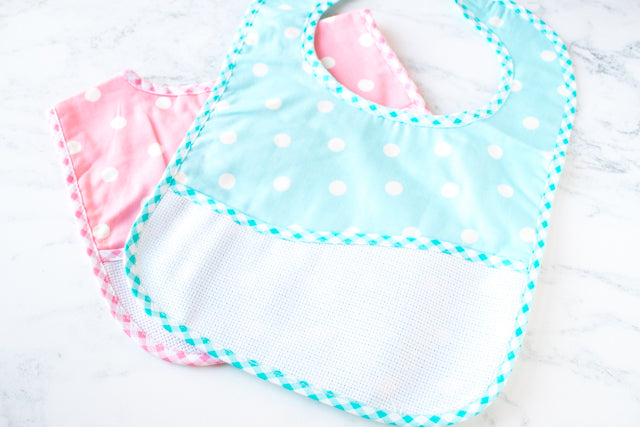
Aida, evenweave, and linen are typically sold in fractions of a yard, most commonly as fat eighths, fat quarters, and fat yards. You can also find Aida and linen fashioned into pre-finished items like tablecloths, towels, bibs, baby booties, and more. These items generally come with a panel of either Aida or linen inset into a larger finished piece.
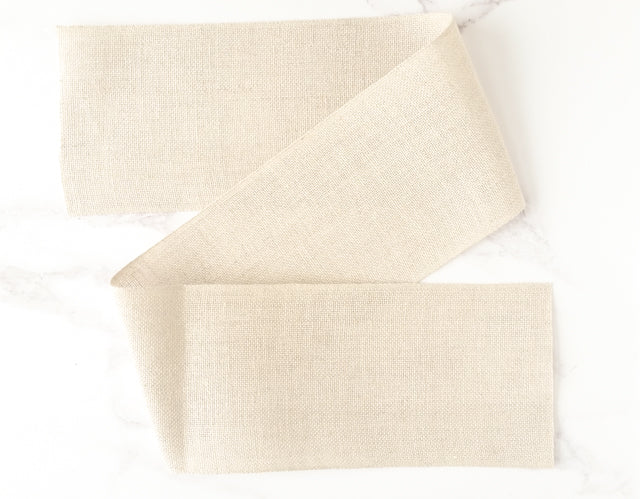
Another option is stitching band, with is a narrow strip of Aida or linen with finished edges. Available in different widths and colors, stitching band can be used for bookmarks, pillow or apron trim, and a number of other household projects.
Looking for fabric for your next project? Be sure to check out our full selection of Aida, evenweave, and linen.